The Licensing Baseline: Non-Negotiable in California
Every roofing contractor working in California must hold an active C-39 Roofing Contractor license issued by the California Contractors State License Board (CSLB). This is not a nice-to-have — it’s the legal requirement for any roofing job exceeding $500 in labor and materials.
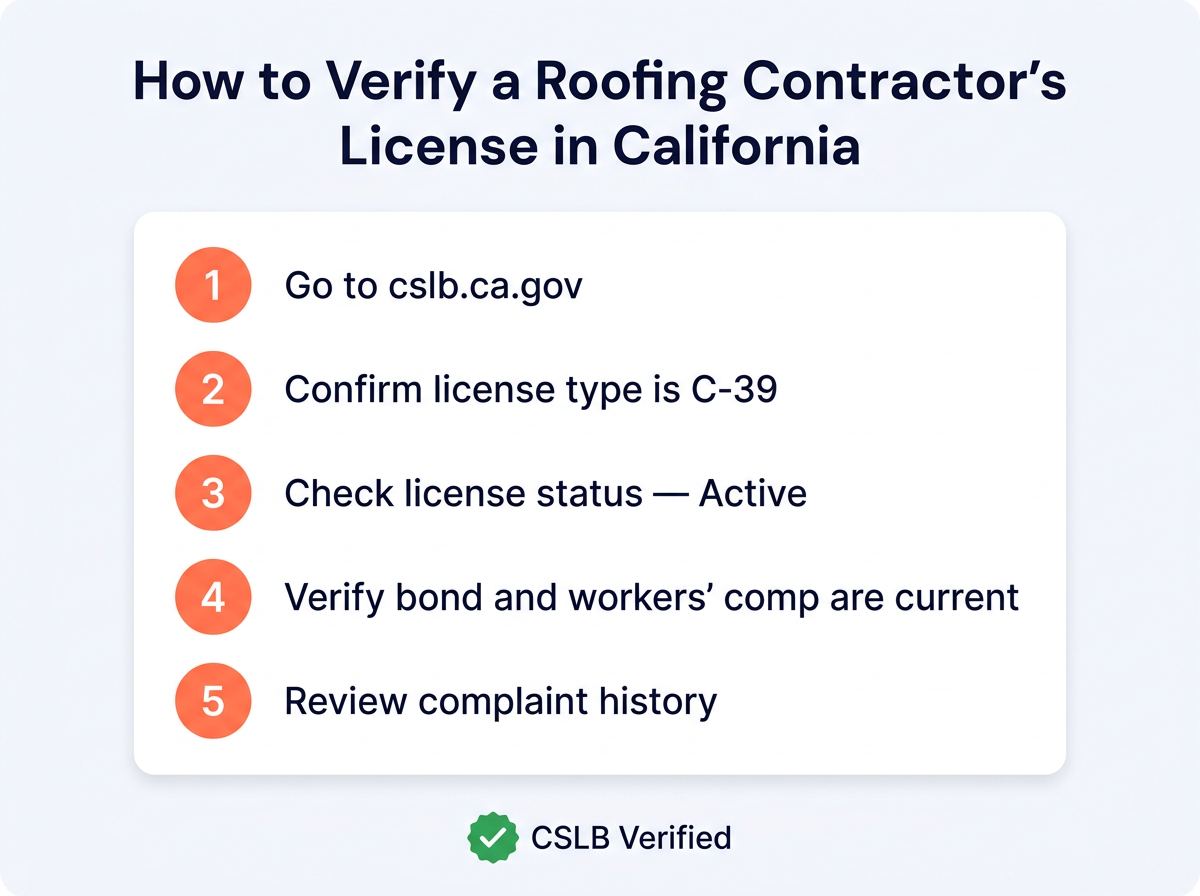
Before you contact a single contractor, verify their license:
- Go to www.cslb.ca.gov and use the License Check tool.
- Confirm the license type is C-39 (Roofing), not a general B license being used to cover roofing work.
- Check the license status (active, not suspended or expired).
- Confirm the bond and workers’ compensation insurance are both current.
- Check the complaint history — any filed complaints appear in the record.
A contractor without an active C-39 cannot legally pull permits in California. If they’re offering to skip permits, that’s your signal to move on.
What to ask directly: “What is your CSLB license number, and can I verify it?” Any reputable contractor will answer without hesitation.
Bay Area-Specific Criteria: Coastal and WUI Environments
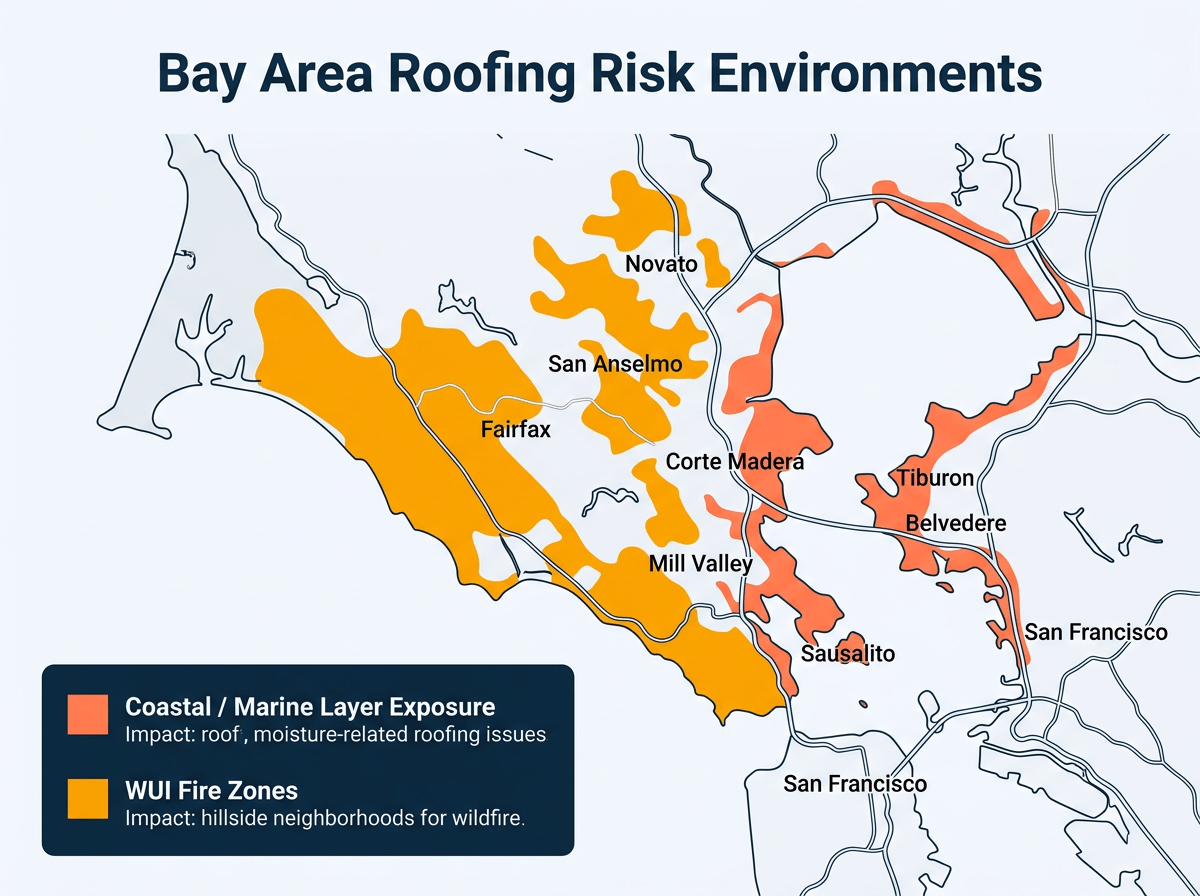
This is where Bay Area homeowners need to apply extra scrutiny. Roofing in Marin County and the greater Bay Area is not equivalent to roofing in Sacramento or the Central Valley.
Coastal and Marine Layer Exposure
Properties in Marin County, Tiburon, Sausalito, Belvedere, Corte Madera, and along the San Francisco waterfront deal with persistent moisture from the marine layer. That moisture accelerates deterioration of improperly installed flashing, flashings at penetrations, and low-slope transitions. Ask contractors directly:
- “Have you worked on homes with persistent coastal moisture exposure?”
- “How do you handle flashing and underlayment spec for coastal conditions?”
- “Which materials do you recommend for high-moisture environments, and why?”
A contractor who gives you a generic answer about asphalt shingles without addressing moisture management is not thinking about your specific roof’s long-term performance.
WUI (Wildland-Urban Interface) Requirements
A significant portion of Marin County — including parts of Mill Valley, Fairfax, San Anselmo, Novato, and the unincorporated hillsides — falls within designated Wildland-Urban Interface zones. WUI designation triggers specific roofing requirements under the California Building Code, including:
- Class A fire-rated roofing assemblies (required in most WUI zones)
- Specific underlayment requirements
- Ridge cap and eave closure specs designed to prevent ember intrusion
- Some jurisdictions require fire-resistant assemblies even for repair work above a certain scope
If your property is in a WUI zone, your contractor must demonstrate familiarity with the specific WUI requirements that apply to your parcel. Confirm they have pulled WUI-compliant permits in your county. Request documentation.
If a contractor is not familiar with WUI requirements in Marin County, do not hire them for a WUI-affected property. The fire risk is too serious, and a non-compliant installation may create liability issues if you need to file an insurance claim.
Evaluating Bay Area Roofers: Reviews, References, and Red Flags
When reading bay area roofers reviews, the patterns you’re looking for go beyond star ratings.
What Strong Reviews Actually Signal
- Specific mention of the project manager or crew lead — indicates a consistent, accountable team
- Reference to the permit and inspection process — signals the contractor does not skip steps
- Comment on communication quality — “they told me what was happening at every stage” is a meaningful differentiator
- Mention of post-project follow-up — especially relevant for larger replacement projects
What to Ignore
- Generic 5-star reviews without detail (“Great job, highly recommend”) — these provide no useful signal
- Reviews that all use identical language — may indicate coached or manufactured reviews
- Review dates clustered unnaturally — a contractor who receives 40 reviews in one week after years of inactivity warrants scrutiny
Reference Calls: What to Ask
Request references from projects completed in the past 18 months, specifically for the service type you’re considering. For a roof replacement, ask:
- “Did the project come in on schedule? If not, what caused the delay?”
- “Were there any surprises in the final cost compared to the estimate?”
- “How did they handle the permit and inspection process?”
- “Would you hire them again?”
One reference who answers these questions in detail is worth more than ten generic 5-star reviews.
Evaluating Estimates: What a Professional Quote Looks Like
A professional roofing estimate from any best-rated roofing company near me search should include — at minimum:
- Itemized scope of work: tear-off vs. overlay, underlayment specification, flashing replacement, penetration details, ridge and hip treatment
- Material specification: manufacturer, product line, color, and weight class for each material component
- Warranty terms: separate lines for workmanship warranty (contractor-backed) and material warranty (manufacturer-backed), with specific durations
- Permit and inspection: explicitly listed as included or explicitly noted if the homeowner is responsible
- Timeline: start date window, estimated duration, and any conditions (weather-dependent phases)
- Payment schedule: tied to milestones, not front-loaded
Red flags in an estimate:
- Lump-sum pricing with no material or scope detail
- No mention of permits
- Payment schedule that requires 50%+ upfront before materials are ordered
- “Lifetime warranty” language without identifying the warranty holder and terms
- Verbal promises not reflected in the written document
The estimate is also a document that reveals how organized and professional a contractor is. Vague estimates tend to produce vague outcomes.
The Permit Question: Why It Matters More Than You Think
In most California jurisdictions, a full roof replacement requires a permit. In Marin County, permit requirements apply to most scope-of-work replacements, and inspections are required at specific project stages.
Homeowners sometimes accept a contractor’s suggestion to skip permits — usually framed as a way to save time or money. This is a mistake for three reasons:
- Insurance claims. If you have a claim related to the roof (water intrusion, structural damage), your insurer may deny coverage if the roof was installed without required permits and inspections.
- Resale. Unpermitted work must be disclosed during sale in California. An unpermitted roof replacement will surface in a home inspection and can complicate or derail a transaction.
- Code compliance. The permit and inspection process is the mechanism that ensures your roof meets current California Building Code requirements, including fire ratings in WUI zones.
The permit cost — typically $300–$800 in most Bay Area municipalities — is not worth skipping.
Summary: The Contractor Evaluation Checklist
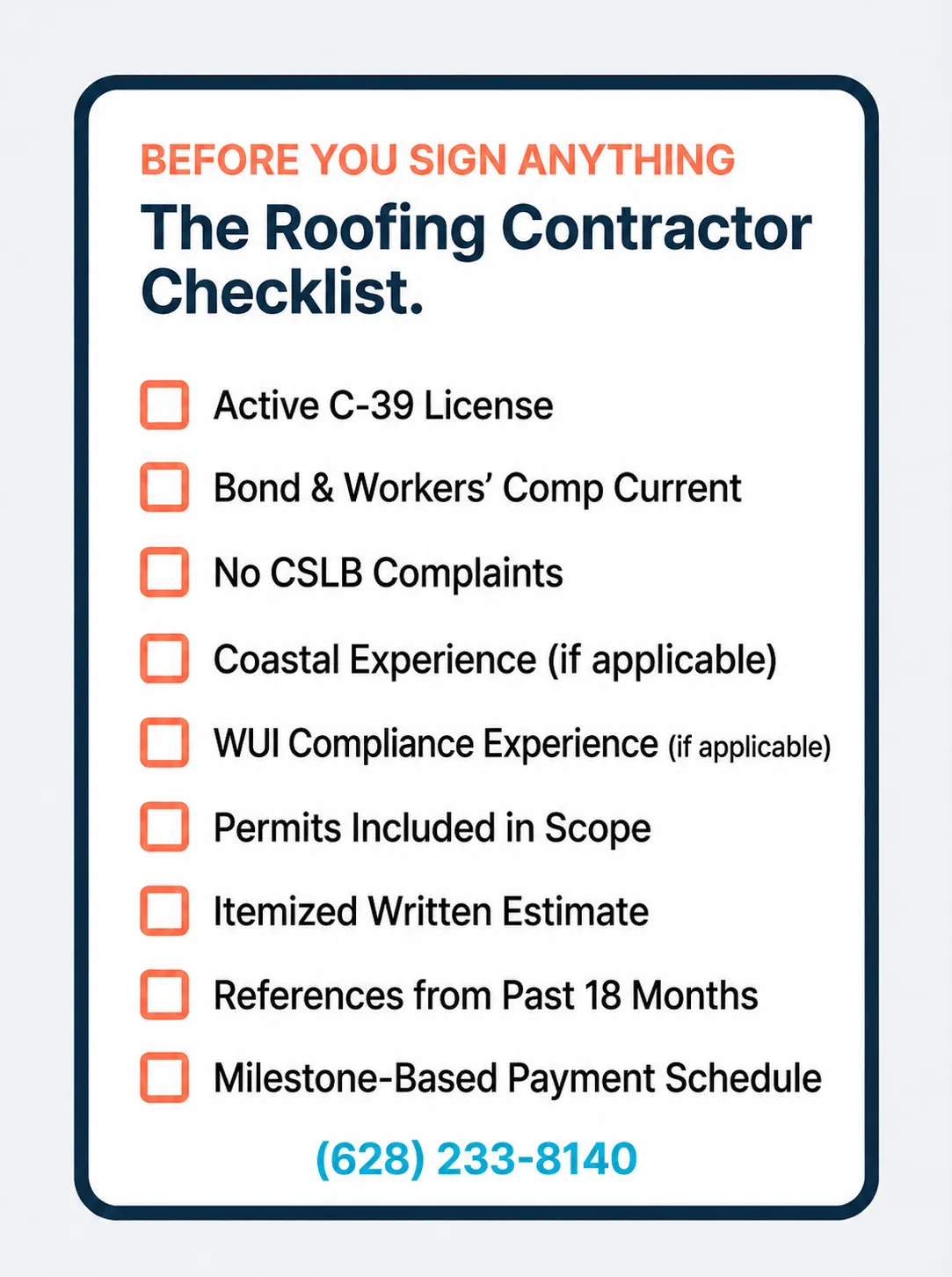
Before signing a roofing contract in the San Francisco Bay Area, confirm the following:
- [ ] Active C-39 license verified on CSLB.ca.gov
- [ ] Active bond and workers’ compensation insurance (not just general liability)
- [ ] No material complaints on CSLB record
- [ ] GAF Master Elite or Owens Corning Preferred status (if applicable to your material choice)
- [ ] Documented experience with coastal moisture conditions (if applicable)
- [ ] Documented experience with WUI compliance (if your parcel is in a WUI zone)
- [ ] Permits and inspections explicitly included in the scope
- [ ] Itemized, written estimate with material specs and warranty terms
- [ ] References from comparable projects in the past 18 months
- [ ] Payment schedule tied to milestones, not front-loaded
A contractor who clears all of these is qualified to work on your home. One who bristles at any of these questions is telling you something important.