Why California Roofing Costs Run Higher Than the National Average
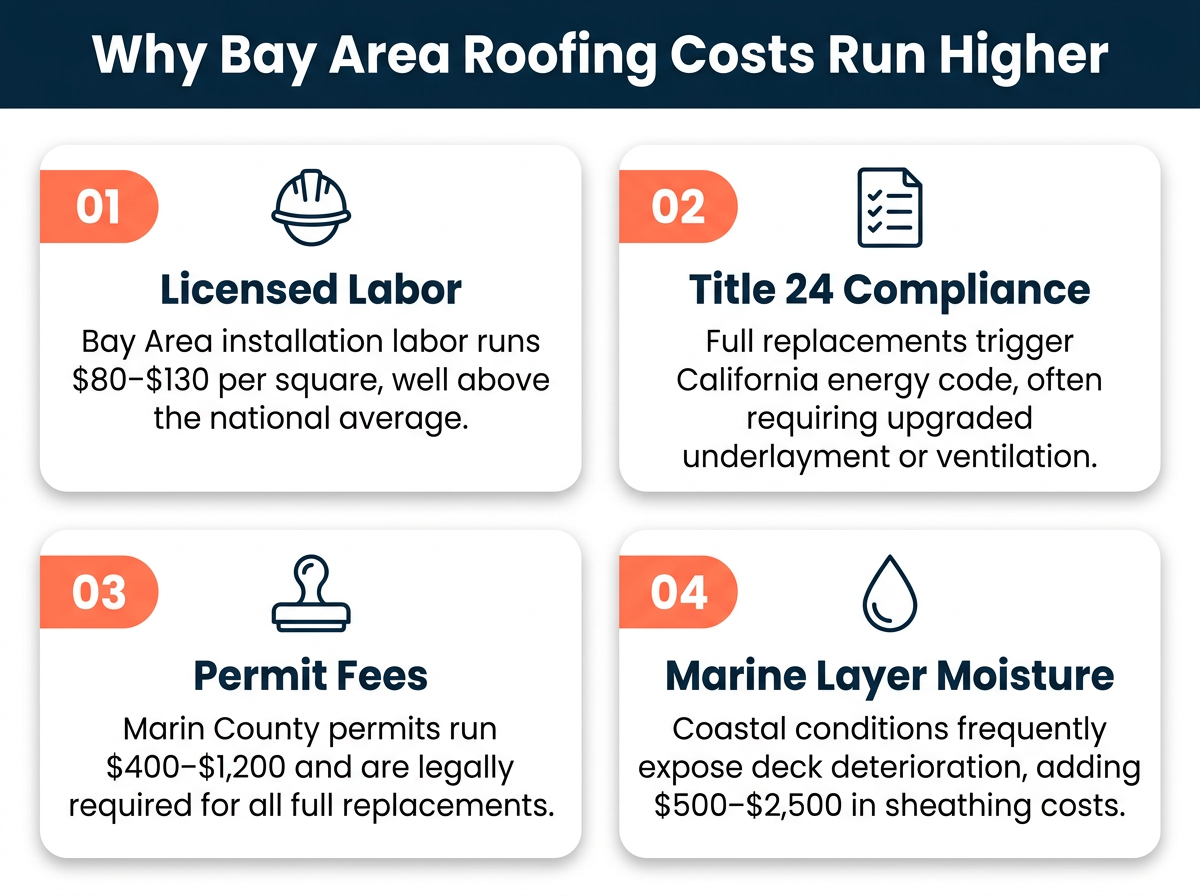
Before you enter a figure into any roof replacement cost estimator for California, it helps to understand the four cost drivers that separate this market from the rest of the country. They compound — meaning each one adds to the next, not simply alongside it.
| |
Factor |
Detail |
| 01 |
Licensed Labor Rates |
California requires CSLB-licensed contractors for all roofing work. Bay Area labor rates typically run $80–$130 per square (100 sq ft) for installation alone. |
| 02 |
Title 24 & Code Compliance |
A full replacement triggers California’s Title 24 energy compliance review, which may require specific underlayment, ventilation upgrades, or cool-roof-rated materials. |
| 03 |
Permit Fees |
Marin County cities charge permit fees based on project valuation. Expect $400–$1,200 for a standard residential replacement. Any estimate excluding permit costs understates the total investment. |
| 04 |
Marine Layer & Moisture |
Coastal moisture demands thorough deck inspections. Discovering and replacing deteriorated sheathing is common in Marin County re-roofs, adding $500–$2,500 in material and labor. |
“In Marin County, most residential roof replacements require a permit regardless of scope or material — a detail that affects your timeline, your financing, and whether your warranty is valid at close.”
New Roof Cost in the Bay Area: Ranges by Material
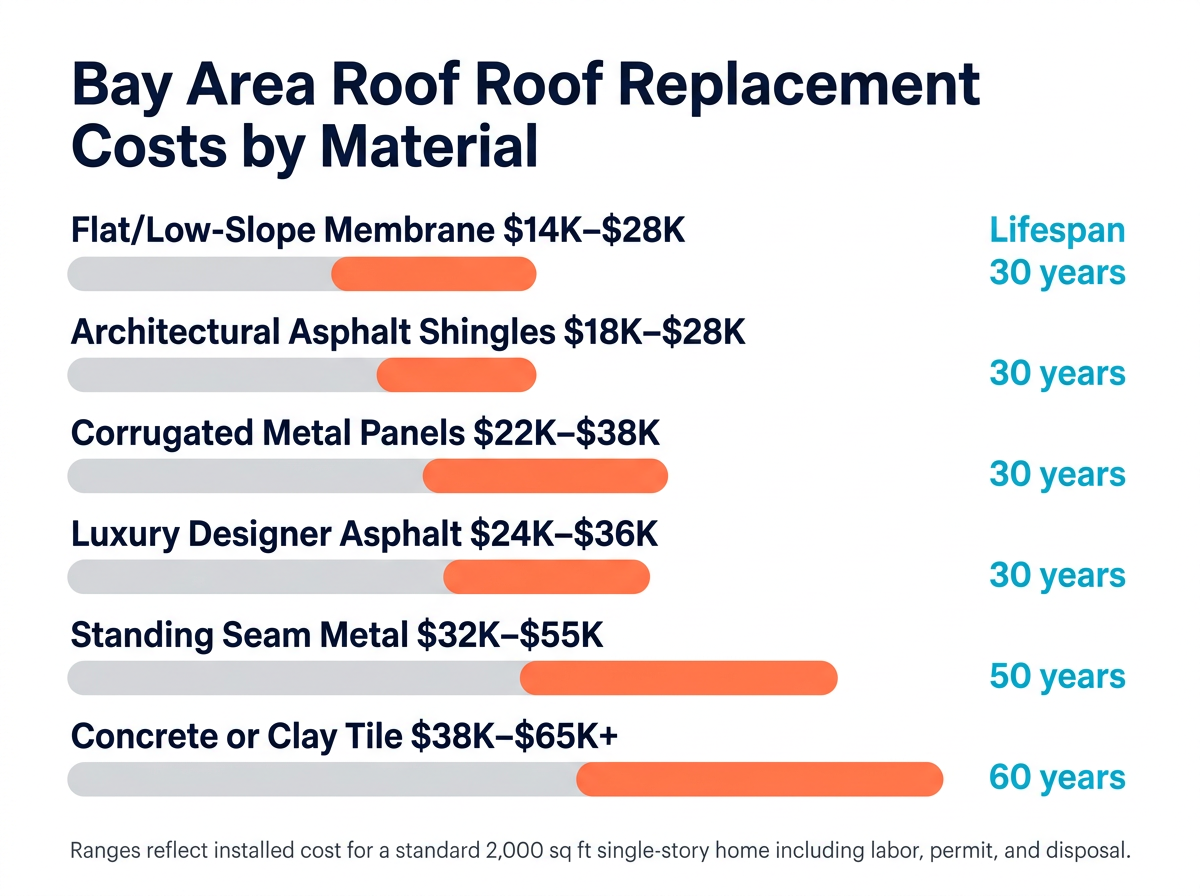
The single largest variable in a roofing estimate is material selection. The table below reflects installed Bay Area cost ranges — including labor, underlayment, flashing, disposal, and permit fees — for a standard 2,000 sq ft single-story home. Steep-pitch roofs, multi-story structures, and complex flashing work will push costs toward the upper end or beyond.
| Material |
Bay Area Range |
Lifespan |
Notes |
| Architectural Asphalt Shingles |
$18,000 – $28,000 |
25–30 yrs |
Most common residential choice. Algae-resistant coatings recommended for Marin County moisture exposure. |
| Luxury / Designer Asphalt |
$24,000 – $36,000 |
30–35 yrs |
Higher profile, thicker construction. Better warranty terms, often preferred for higher-value homes. |
| Standing Seam Metal |
$32,000 – $55,000 |
40–60 yrs |
Excellent moisture resistance. Higher upfront cost often justified by longer warranty and lower lifecycle cost. |
| Corrugated Metal Panels |
$22,000 – $38,000 |
35–50 yrs |
Strong performer in coastal climates at a lower entry cost than standing seam. |
| Flat / Low-Slope Membrane (TPO/EPDM) |
$14,000 – $28,000 |
20–30 yrs |
Commercial and residential flat roofs. Cost varies significantly by square footage and membrane spec. |
| Concrete or Clay Tile |
$38,000 – $65,000+ |
40–50 yrs |
Common in older Bay Area homes. Structural assessment required — many homes need deck reinforcement to support tile weight. |
On Using a Roof Replacement Cost Estimator in California
Online estimators are useful for setting a budget range, but they cannot account for site-specific variables: roof pitch, existing deck condition, local permit fees, or the disposal cost of layered materials. Use an estimator to calibrate your expectations, then confirm the number with an on-site inspection before committing to scope or financing. Our free cost estimator is built specifically for California — and accounts for Bay Area labor rates and permit requirements that national tools miss.
What Affects the Final Number: Line Items Homeowners Often Overlook
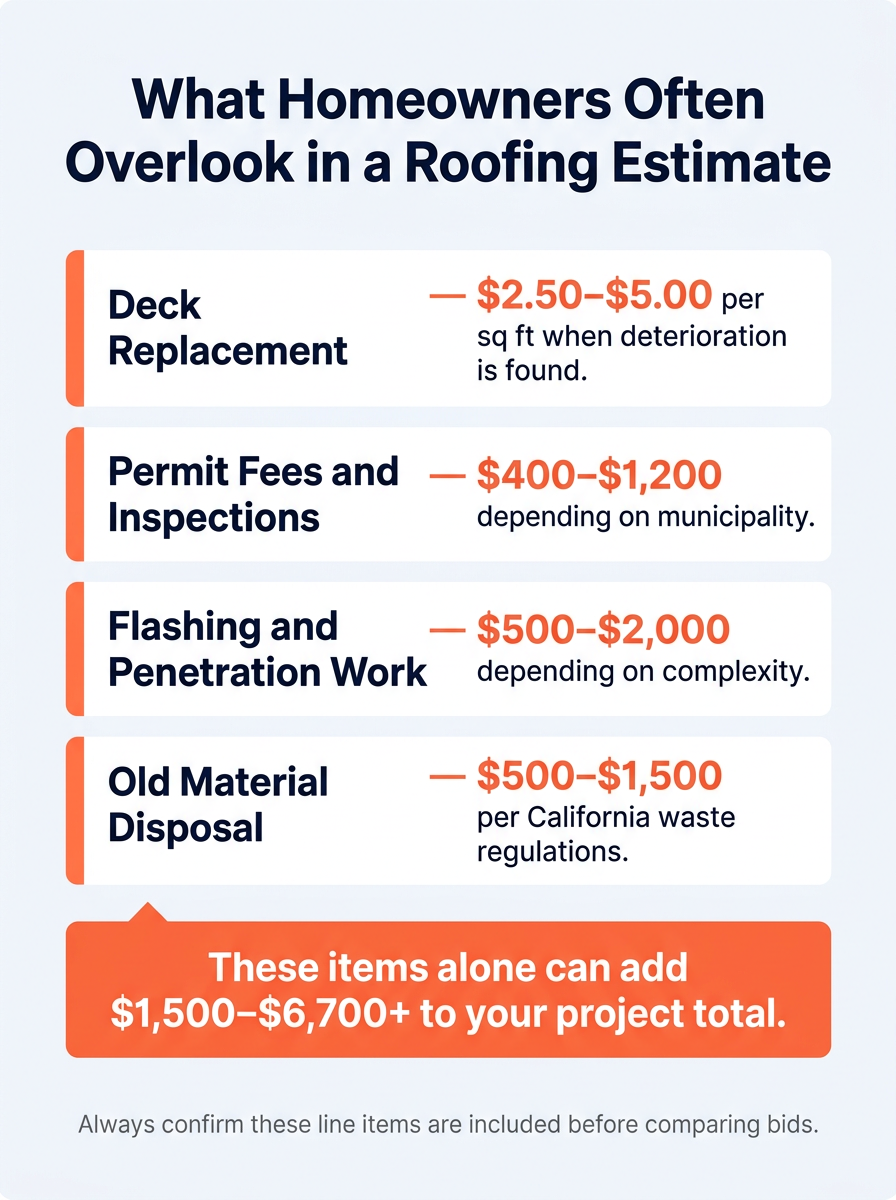
The material cost is only one component of what you’ll actually pay. These are the line items that consistently surprise homeowners seeing a final estimate for the first time — and each is legitimate when the scope justifies it.
Deck Replacement and Structural Repair
Once the old roof is stripped, the condition of the underlying sheathing becomes visible. In Marin County, moisture infiltration over years of marine layer exposure frequently means partial or full deck board replacement. Budget $2.50–$5.00 per square foot for deck replacement when deterioration is found — and ask your contractor what they charge before the job starts so there are no surprises.
Permit Fees and Inspections
A full re-roof in San Rafael, Mill Valley, Novato, or any Marin County municipality requires a building permit. Inspection scheduling adds 1–3 days to your timeline (not weeks, when scheduled correctly). Any contractor telling you a permit isn’t required for a full replacement should be asked to show you the code citation. It is required.
Flashing and Penetration Work
Chimneys, skylights, vents, and valleys all require new or upgraded flashing on a full replacement. Failing to replace flashing on a new roof is the most common source of leak callbacks within the first two years. Expect $500–$2,000 in flashing costs depending on the number and complexity of penetrations.
Old Material Disposal
Removing and disposing of old roofing material runs $500–$1,500 depending on the number of existing layers, the material type, and local disposal rates. California has strict landfill requirements for construction debris that push disposal costs above the national average.
Roofing Costs in California: The Marin County Premium
Roofing costs in California run approximately 25–40% above national averages. Within the state, the San Francisco Bay Area — and Marin County specifically — sits at the higher end of California markets, driven by labor costs, regulatory complexity, and coastal climate requirements. A project that would cost $15,000 in Sacramento often runs $20,000–$28,000 for equivalent scope in Marin County.
This is not a reason to delay a necessary replacement. A failing or aging roof exposes Marin County homes — where property values average well above state medians — to water infiltration damage that compounds rapidly in a high-moisture coastal environment.
Why “Getting Three Bids” Can Mislead You in This Market
The standard homeowner advice to collect three bids assumes those bids are scoping the same project. In practice, a significant cost gap usually reflects differences in scope: one contractor includes full deck inspection and flashing replacement, another does not. Before comparing prices, confirm each bid includes the same line items — permit fees, deck inspection, flashing, underlayment spec, and warranty terms. Price differences after that comparison are meaningful. Price differences before it are noise.
How to Use a Roof Replacement Cost Estimator for California
A well-built California roof replacement cost estimator does three things a generic national tool cannot: it applies Bay Area labor rates rather than national averages, it factors in permit cost by county or municipality, and it accounts for California-specific material requirements like Title 24 cool-roof compliance.
To get an accurate estimate, you’ll need four inputs:
• Roof square footage — Measure your home’s footprint and add 10–15% for pitch factor. Your roofing contractor will measure precisely during an inspection, but a footprint estimate gets you close for budgeting.
• Roof pitch — Low-pitch (2:12–4:12), standard (4:12–6:12), and steep (7:12+) roofs have meaningfully different labor costs. Steep-pitch work adds $1,000–$3,500 to a standard estimate.
• Material preference — Use the table above to anchor your material selection against your budget and timeline goals.
• Location — Input your Marin County city or Bay Area zip code to apply local permit and labor rate calibration.
Estimator vs. On-Site Inspection
Use the estimator to establish your budget range and evaluate financing options. Use the on-site inspection to confirm scope, identify hidden conditions, and lock in a final number. The estimator is a planning tool — the inspection is the contract foundation. We recommend doing both in sequence before committing to any project.